How does 3D surgical planning work?

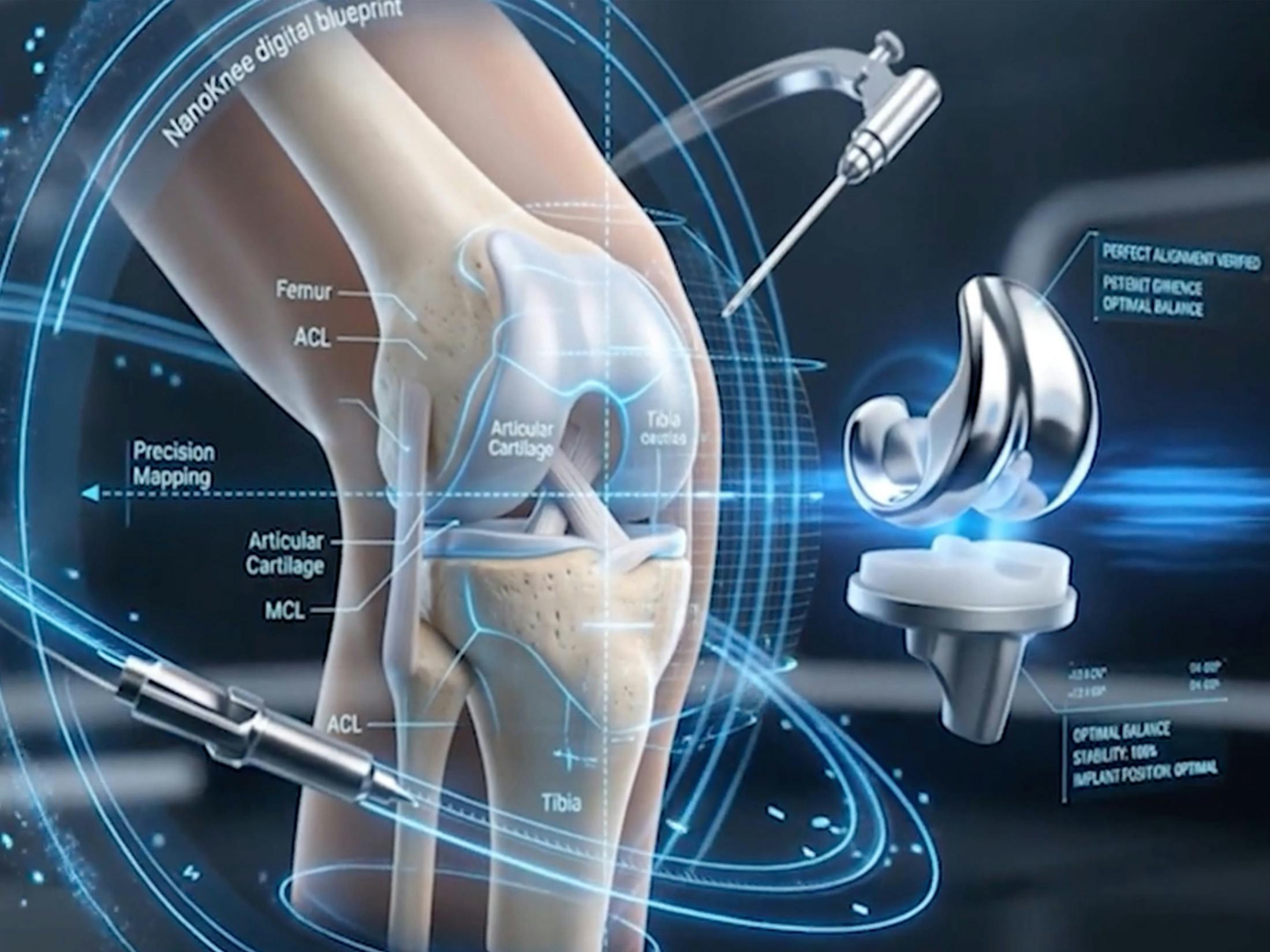
  • CT scan. Your journey starts with a CT scan of your hip, knee, and ankle using the NanoKnee imaging protocol. By capturing your entire leg, NanoKnee looks beyond the knee to understand your unique alignment from hip to ankle.
  • Digital reconstruction. Your CT scan is transformed into a detailed 3D model of your bones and joint surfaces, creating a digital representation of your anatomy to plan your procedure with precision.
  • Engineering plan. NanoKnee’s biomedical engineers use your 3D model to virtually restore your joint surfaces and biomechanical alignment. They then determine the implant size and plan its position, rotation, and alignment based on your unique bone anatomy, accounting for bone shape, wear pattern, and ligament balance through the full range of motion.
  • Surgeon review. This is where our 3D planning comes to life. Your surgeon enters the operating room with a personalized surgical plan built around your unique anatomy, alignment, implant positioning and biomechanics. Every detail has been thoughtfully prepared, so your surgeon doesn’t need to make critical decisions during the time crunch of your surgery.
  • Surgery. Your surgeon performs the procedure using the approved plan as a guide.
  • After Surgery. Your surgeon and the rest of the NanoKnee team follows your recovery process, to ensure that post-surgical milestones are being met, and that you can return to the activities that you love.

The NanoKnee Model

NanoKnee isn't a surgical practice or implant manufacturer. We're a collaborative network of board-certified surgeons, biomedical engineers, and business leaders dedicated to helping joint replacement patients move freely. All of our surgeons run independent, private practices, and we do not interfere with their patient relationships, offerings, or internal workflows.

Behind every procedure is a biomedical engineering team that develops a detailed digital surgical blueprint for each patient case. We focus on consistent surgical planning, muscle-sparing methods, and high-quality patient experiences.

Does 3D planning mean I get a custom implant?

What’s customized is your plan, not the implant. NanoKnee uses FDA-cleared implants from established manufacturers with long-term clinical track records; the plan decides how the implant is sized, positioned, and aligned to your anatomy. This gives you the precision of patient-specific planning with the durability data of proven implant designs.

How is this different from robotic knee replacement?

Robotic-assisted knee replacement uses a robotic arm or cutting system to help the surgeon make bone cuts during the operation. NanoKnee’s approach is different: the sizing, alignment, and balancing decisions are worked out before surgery on a 3D model built from your own CT scan, then reviewed and approved by your surgeon. The question patients should ask about any technology is whether it has been shown to produce a better knee. For robotics, the published evidence has not shown that.

What the research shows about robotic knee replacement

Robotic systems do place implants closer to the surgeon’s intended target on X-ray. That part of the evidence is consistent. What the evidence has not shown is that this translates into a better result for the patient:

  • No better long-term outcomes. In the largest randomized trial to date (1,406 patients followed for a mean of 13 years), robotic-assisted and conventional knee replacement showed no differences in function scores, implant loosening, survivorship, or complications. The authors concluded that, given the added time and expense, they could not recommend widespread use of robotic surgery.[1]
  • No better results at two years in a modern, blinded trial. A 2026 multicenter randomized trial of 303 patients (RASKAL, nested in the Australian joint registry) found that robotic-assisted surgery was not superior to computer-navigated surgery in pain and function scores at three months, six months, one year, or two years.[2]
  • No better clinical outcomes across randomized trials, and longer operations. A 2023 meta-analysis of 14 randomized trials (2,285 patients) found robotic surgery did not provide superior clinical or radiological outcomes overall, added about 15 minutes to operative time, and had complication rates similar to conventional surgery.[3]
  • No reduction in early revisions in U.S. registry data. Analyses of the American Joint Replacement Registry found no difference in the odds of revision within two years between robotic-assisted and conventional knee replacement, including for cementless implants, where robotics had been expected to help most.[4][5]

Some trials report modest early advantages, most often in pain during the first months after surgery,[6] and long-term data on the newest systems are still accumulating. But after more than a decade of study, robotic knee replacement has not been shown to produce a better-functioning or longer-lasting knee than a well-planned, well-executed conventional procedure.

What it adds

Robotic surgery adds equipment, a pre-operative CT or registration step, additional time in the operating room, and a learning curve for the surgical team.[3] It also adds cost, which is one reason the authors of the longest randomized trial could not recommend its widespread use.[1] Those are reasonable trade-offs if the result is a better knee. The evidence to date does not show that it is.

Why NanoKnee plans before surgery instead

The decisions that matter most in a knee replacement are made before the first cut: which implant size fits your bone, where it sits, how it is aligned to your leg, and how your ligaments will be balanced through your range of motion. NanoKnee makes those decisions on a 3D model of your actual anatomy, with time to get them right, rather than relying on an intra-operative device to execute a plan formed in the operating room. Your surgeon then performs the procedure with a proven implant and a plan they have already reviewed and approved.

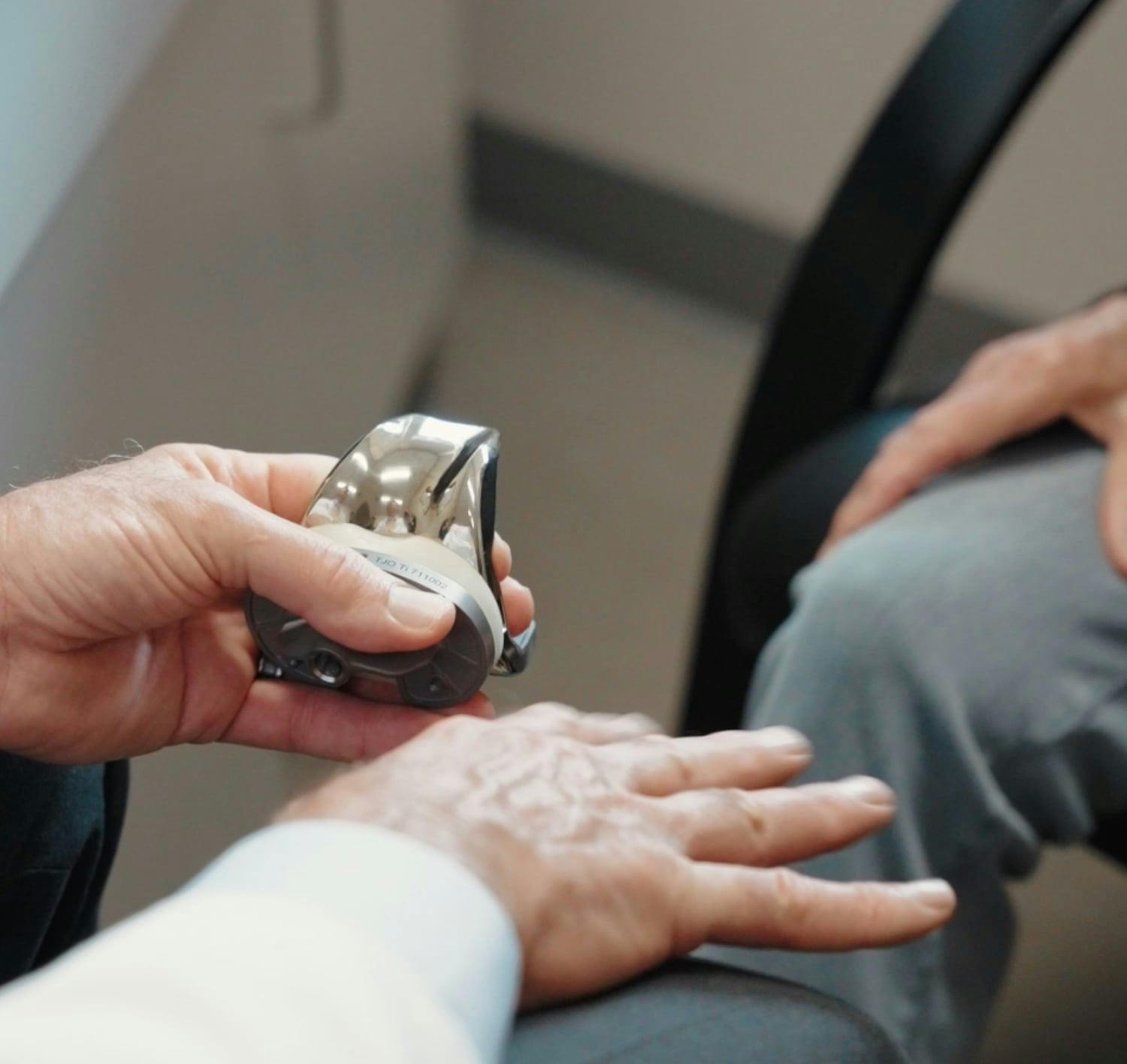
doctor with 3D model

Does NanoKnee use a muscle-sparing surgical approach?

Yes, for appropriate candidates. NanoKnee partner surgeons perform knee replacement through a quadriceps-sparing (subvastus) approach that reaches the joint without cutting the quadriceps tendon. Randomized trials show this approach offers modest early advantages, such as less pain in the first days after surgery, with results equivalent to the standard approach thereafter.[7] The surgical approach and the surgical plan are complementary: a muscle-sparing approach can make the first weeks easier, and a 3D plan addresses the sizing, alignment, and balance that determine how the knee performs for years. Your surgeon will discuss which approach fits your anatomy and history.

Is artificial intelligence used in my surgery?

AI is used only in pre-operative planning. NanoKnee incorporates proprietary AI algorithms to make parts of the engineers' measurement work faster and more consistently; the engineers and your surgeon still review and approve every plan. Nothing in the operating room is automated; your surgeon performs the procedure with the assistance of a detailed 3D surgical plan tailored to your unique anatomy.

What imaging will I need?

A CT scan following the NanoKnee imaging protocol. We have established a nationwide network of approved imaging vendors to ensure consistency and convenience for our patients. Your surgeon will let you know if any additional imaging is needed for your case.

Is 3D planning used for hip and revision surgery?

Yes. NanoKnee applies the same CT-based planning to knee and hip replacement, and uses it to plan complex revision procedures, where seeing existing hardware, bone loss, and alignment in three dimensions gives your surgeon detail that plain X-rays cannot provide.

Banner media

Does 3D planning guarantee a faster recovery?

Studies consistently find that about one in five knee replacement patients are not satisfied with their results, [8], and many of the reasons trace back to decisions made before and during surgery. What NanoKnee’s 3D planning addresses are the factors the surgical team can control in advance: the implant size, its position and alignment relative to your bone, and the restoration of your natural joint surfaces and ligament balance. Getting the size right before surgery

Getting the size right before surgery

Standard X-ray templating predicts the correct implant size surprisingly poorly. In one large arthroplasty-center review of 482 knees, X-ray templating matched the implant actually used in only 34% of cases,[9] and in a blinded study the range was roughly 44–68% depending on the observer.[10] CT-based 3D templating, by contrast, predicted the femoral component correctly 96.6% of the time and the tibial component 93.1% of the time in a prospective series, versus 52.9% and 28.7% for 2D templating of the same knees.[11] Knowing the correct size before surgery means fewer decisions made under time pressure in the operating room.

Getting the position and alignment right

How the components are positioned relative to your bone affects how long the implant lasts. In a review of 6,070 knee replacements, component malposition in the coronal plane was associated with higher failure rates, and “correcting” one poorly positioned component by adjusting the other increased the risk of failure further.[12] A 3D plan lets the engineering team and your surgeon see the position of every component relative to your entire leg, from hip to ankle, before surgery, rather than estimating it from a flat X-ray.

Restoring your natural joint, not a textbook average

Healthy knees are not all built the same: a substantial share of adults naturally stand with a knee that is not in “neutral” mechanical alignment.[13] NanoKnee’s plans are built on kinematic alignment principles: rather than forcing every knee to the same neutral target, the plan restores the joint lines and alignment your knee had before arthritis. This approach has been tested in randomized trials:

  • Better pain relief and function at two years. In a blinded randomized trial of 88 patients, kinematically aligned knees planned from 3D imaging and executed with patient-specific guides had better Oxford Knee Scores (40 vs. 33), better WOMAC scores (15 vs. 26), and greater flexion (121° vs. 113°) than mechanically aligned knees at two years. The odds of a pain-free knee were three to five times higher.[14]
  • Durable at 13 years. The same trial’s 13-year follow-up found no difference in reoperations or complications between the two groups, with 96% of kinematically aligned patients satisfied versus 82% (a difference that did not reach statistical significance).[15]
  • Consistent across trials. Meta-analyses of randomized trials (1,112 patients across the trials in one analysis; 21 trials in a 2026 update) found kinematic alignment produced better WOMAC and Knee Society scores and greater knee flexion, with no increase in complications or revision, and fewer ligament releases during surgery.[16][17]
  • Safe at the registry level. Combined Australian and New Zealand registry data on more than 20,000 knee replacements found a similar risk of revision for kinematically aligned, patient-specific-instrumented knees as for all other knee replacements,[18] and a single-center series reported 98% implant survival at 10 years for kinematically aligned knees.[19]

None of this replaces the work of recovery, and your surgeon and physical therapy team will guide that. What a 3D plan does is remove avoidable sources of error before surgery begins, so the knee you rehabilitate is the right size, in the right position, aligned to your anatomy, and balanced through its range of motion.

Who creates my plan, and does my surgeon still make the decisions?

Your Nano 3D Blueprinting plan is built by NanoKnee’s biomedical engineering team and reviewed and approved by your surgeon before surgery. Your surgeon makes every clinical decision; the plan is a tool that puts more information in their hands.

doctors

Sources

  1. Kim YH, Yoon SH, Park JW. Does robotic-assisted TKA result in better outcome scores or long-term survivorship than conventional TKA? A randomized, controlled trial. Clin Orthop Relat Res. 2020;478(2):266-275. doi:10.1097/CORR.0000000000000916
  2. MacDessi SJ, Wernecke GC, Ghadirinejad K, et al.; RASKAL Study Group. Robotic-assisted surgery and functional alignment in total knee arthroplasty: the RASKAL registry-nested 2 × 2 factorial randomized trial. Bone Joint J. 2026;108-B:622-633. doi:10.1302/0301-620X.108B.BJJ-2025-1472.R2
  3. Bensa A, Sangiorgio A, Deabate L, Illuminati A, Pompa B, Filardo G. Robotic-assisted mechanically aligned total knee arthroplasty does not lead to better clinical and radiological outcomes when compared to conventional TKA: a systematic review and meta-analysis of randomized controlled trials. Knee Surg Sports Traumatol Arthrosc. 2023;31(11):4680-4691. doi:10.1007/s00167-023-07458-0
  4. Kirchner GJ, Stambough JB, Jimenez E, Nikkel LE. Robotic-assisted TKA is not associated with decreased odds of early revision: an analysis of the American Joint Replacement Registry. Clin Orthop Relat Res. 2024;482(2):303-310. doi:10.1097/CORR.0000000000002783
  5. Kirchner GJ, Stambough JB, Jimenez E, Nikkel LE. Robotic assistance is not associated with decreased early revisions in cementless TKA: an analysis of the American Joint Replacement Registry. Clin Orthop Relat Res. 2025;483(3):431-438. doi:10.1097/CORR.0000000000003330
  6. Clement ND, Galloway S, Baron YJ, Smith K, Weir DJ, Deehan DJ. Robotic Arm-assisted versus Manual (ROAM) total knee arthroplasty: a randomized controlled trial. Bone Joint J. 2023;105-B(9):961-970. doi:10.1302/0301-620X.105B9.BJJ-2023-0006.R3
  7. Berstock JR, Murray JR, Whitehouse MR, Blom AW, Beswick AD. Medial subvastus versus the medial parapatellar approach for total knee replacement: a systematic review and meta-analysis of randomized controlled trials. EFORT Open Rev. 2018;3(3):78-84. doi:10.1302/2058-5241.3.170030
  8. Bourne RB, Chesworth BM, Davis AM, Mahomed NN, Charron KDJ. Patient satisfaction after total knee arthroplasty: who is satisfied and who is not? Clin Orthop Relat Res. 2010;468(1):57-63. doi:10.1007/s11999-009-1119-9
  9. Riechelmann F, Lettner H, Mayr R, Tandogan R, Dammerer D, Liebensteiner M. Imprecise prediction of implant sizes with preoperative 2D digital templating in total knee arthroplasty. Arch Orthop Trauma Surg. 2023;143(8):4705-4711. doi:10.1007/s00402-023-04772-7
  10. Ettinger M, Claassen L, Paes P, Calliess T. 2D versus 3D templating in total knee arthroplasty. Knee. 2016;23(1):149-151. doi:10.1016/j.knee.2015.08.014
  11. Pietrzak JRT, Rowan FE, Kayani B, Donaldson MJ, Huq SS, Haddad FS. Preoperative CT-based three-dimensional templating in robot-assisted total knee arthroplasty more accurately predicts implant sizes than two-dimensional templating. J Knee Surg. 2019;32(7):642-648. doi:10.1055/s-0038-1666829
  12. Ritter MA, Davis KE, Meding JB, Pierson JL, Berend ME, Malinzak RA. The effect of alignment and BMI on failure of total knee replacement. J Bone Joint Surg Am. 2011;93(17):1588-1596. doi:10.2106/JBJS.J.00772
  13. Bellemans J, Colyn W, Vandenneucker H, Victor J. The Chitranjan Ranawat Award: is neutral mechanical alignment normal for all patients? The concept of constitutional varus. Clin Orthop Relat Res. 2012;470(1):45-53. doi:10.1007/s11999-011-1936-5
  14. Dossett HG, Estrada NA, Swartz GJ, LeFevre GW, Kwasman BG. A randomised controlled trial of kinematically and mechanically aligned total knee replacements: two-year clinical results. Bone Joint J. 2014;96-B(7):907-913. doi:10.1302/0301-620X.96B7.32812
  15. Dossett HG, Arthur JR, Makovicka JL, Mara KC, Bingham JS, Clarke HD, Spangehl MJ. A randomized controlled trial of kinematically and mechanically aligned total knee arthroplasties: long-term follow-up. J Arthroplasty. 2023;38(6S):S209-S214. doi:10.1016/j.arth.2023.03.065
  16. Liu B, Feng C, Tu C. Kinematic alignment versus mechanical alignment in primary total knee arthroplasty: an updated meta-analysis of randomized controlled trials. J Orthop Surg Res. 2022;17:201. doi:10.1186/s13018-022-03097-2
  17. Kinematic versus mechanically aligned total knee arthroplasty: a meta-analysis of randomized controlled trials. J Knee Surg. 2026. doi:10.1055/a-2741-1246
  18. Klasan A, de Steiger R, Holland S, Hatton A, Vertullo CJ, Young SW. Similar risk of revision after kinematically aligned, patient-specific instrumented total knee arthroplasty, and all other total knee arthroplasty: combined results from the Australian and New Zealand Joint Replacement Registries. J Arthroplasty. 2020;35(10):2872-2877. doi:10.1016/j.arth.2020.05.065
  19. Howell SM, Shelton TJ, Hull ML. Implant survival and function ten years after kinematically aligned total knee arthroplasty. J Arthroplasty. 2018;33(12):3678-3684. doi:10.1016/j.arth.2018.07.020

Find your Knee Surgeon Your comeback starts here

Schedule a Consultation
Contact us media
Accessibility: If you are vision-impaired or have some other impairment covered by the Americans with Disabilities Act or a similar law, and you wish to discuss potential accommodations related to using this website, please contact our Accessibility Manager at (888) 492-0598.
Contact Us